Monday, May 16, 2022

Resolving the subtypes of COVID-19 in the elderly

SARS-Cov-2 is one of the most complex viruses known to medical science. Patients with COVID-19 present a broad spectrum of clinical manifestations, ranging from asymptomatic infection to lethal outcome. Both the young and the old may have very different clusters of symptoms and responses to medications, including the COVID-19 vaccines.  Each type is associated with how severe of an illness a patient might experience, ranging from asymptomatic to lethal. 


Precision medicine approaches such as whole-exome sequencing can provide insight into the phenotypes, endotypes and underlying mechanisms of the disease. The high cost of cutting-edge approaches, however, keeps these tools out of reach for many research teams. 

In this age of big data and large clinical studies, we should not forget about the value of individual cases. A good case report tells a detailed story. It describes a unique phenotype and offers unique clues to its resolution into an endotype. 

A new systematic review of case reports aims to answer questions about COVID-19 subtypes in octogenarians, nonagenarians, and centenarians and offer possible solutions to organize the knowledge and identify the gaps. 


REFERENCE

Irene S. Gabashvili. The outcomes of COVID-19 vaccination and SARS-CoV-2 infection in octogenarians, nonagenarians, and centenarians. PROSPERO 2022 CRD42022332621 Available from: https://www.crd.york.ac.uk/prospero/display_record.php?ID=CRD42022332621

Irene S. Gabashvili (2022), “COVID-19 vaccine and SARS-CoV-2 in the oldest old: rapid literature review”, Mendeley Data, v1 http://dx.doi.org/10.17632/6sk33d9z7s.1 https://data.mendeley.com/datasets/6sk33d9z7s/1

Irene S. Gabashvili (2022), “The Outcomes of COVID-19 and Vaccination in the Oldest Old: a Longitudinal Observational Study and Literature Review”, April 2022, DOI: 10.13140/RG.2.2.15625.93285

Thursday, March 3, 2022

Getting Out of Echo Chambers

Web search is hyper personalized and social media creates echo chambers. 

Nothing new, really. "The Facebook effect" was coined over 10 years ago, and the echo chamber effect of the Internet was known long before that.  Echo chambers existed even in the early blogosphere. But the isolation from a diversity of views and opinions may be reaching the tipping point. 

A study published last month in PLOS One, analyzed and visualized 60 billion tweets demonstrating how highly the vaccine debate is polarized. 

Users with similar stances interacted preferentially with one another. Interactions between individuals with different views were rare and not productive.  Extending this insight, the authors provide evidence of an epistemic echo chamber effect, where users are exposed to highly dissimilar sources of information, depending on the stance of their contacts. 

But does it make sense to call an article or a blog post provaxx or antivaxx based on pro- or anti-vaccine sentiment?

Why can't we discuss pros and cons of vaccines objectively and admit that medicine should be personalized? Majority of population benefits from vaccines, but there are those that don't. Should not we try to understand why?

The only way to overcome hyperpolarization is to increase our collective cultural intelligence, improve critical thinking skills, counteract destructive polarizationrecognize the legitimacy and ongoing necessity of opposing viewpoints.

The new.aurametrix.com site is a collection of scientific papers about the less discussed medical cases. We all know that vaccines work. We dare you to understand why there are cases when they don't. 


REFERENCES

Less Discussed Medical Case Reports

Mønsted B, Lehmann S. Characterizing polarization in online vaccine discourse—A large-scale study. PloS one. 2022 Feb 9;17(2):e0263746.

Ries M. The COVID-19 Infodemic: Mechanism, Impact, and Counter-Measures—A Review of Reviews. Sustainability. 2022 Jan;14(5):2605.

Gorman, J. M., & Scales, D. A. (2022). Leveraging infodemiologists to counteract online misinformation: Experience with COVID-19 vaccines. Harvard Kennedy School (HKS) Misinformation Review. https://doi.org/10.37016/mr-2020-92

Saturday, December 25, 2021

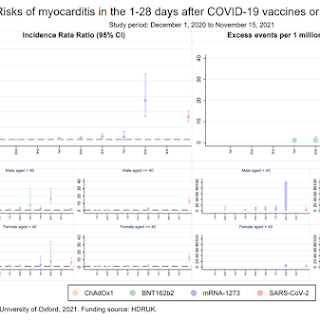
Myocarditis and COVID-19: for some people the risk may be higher following vaccination than infection

COVID-19 is a known cause of cardiac complications such as myocarditis and systolic dysfunction. Vaccine associated myocarditis was described following smallpox vaccination, streptococcal pneumonia and influenza vaccine. In some cases, autoimmune/inflammatory syndrome induced by adjuvants used in the vaccine have been also implicated. 

Associations of COVID-19 vaccination and myocarditis have been proposed in multiple publications, but the consensus was that the benefits of vaccine are worth the increased risk even though more personalized approach seems warranted by the evidence.

A new study presents data about the risk of myocarditis increasing with each subsequent dose of mRNA vaccines, especially mRNA-1273. Moreover, in younger males the risk of myocarditis was higher following vaccination than infection. Another study presents a case of fatal breakthrough infection in an older male who experienced myocarditis-like symptoms after his COVID-19 vaccine. Retrospective cohort study of 196,992 adults in Israel did not observe an increased incidence of neither pericarditis nor myocarditis in unvaccinated adult patients recovering from COVID-19 infection. See example case reports

REFERENCES

Martina Patone, Winnie Xue Mei, Lahiru Handunnetthi, Sharon Dixon, Francesco Zaccardi, Manu Shankar-Hari, Peter Watkinson, Kamlesh Khunti, Anthony Harnden, Carol AC Coupland, Keith M. Channon, Nicholas L Mills, Aziz Sheikh, Julia Hippisley-Cox Risk of myocarditis following sequential COVID-19 vaccinations by age and sex  medRxiv 2021.12.23.21268276; doi: https://doi.org/10.1101/2021.12.23.21268276

Kim HW, Jenista ER, Wendell DC, Azevedo CF, Campbell MJ, Darty SN, Parker MA, Kim RJ. Patients with acute myocarditis following mRNA COVID-19 vaccination. JAMA cardiology. 2021 Oct 1;6(10):1196-201.

Lazaros G, Anastassopoulou C, Hatziantoniou S, Kalos T, Soulaidopoulos S, Lazarou E, Vlachopoulos C, Vassilopoulos D, Tsakris A, Tsioufis C. A case series of acute pericarditis following COVID-19 vaccination in the context of recent reports from Europe and the United States. Vaccine. 2021 Oct 29;39(45):6585-90.

Hendren NS, Carter S, Grodin JL. Severe COVID-19 vaccine associated myocarditis: Zebra or unicorn?. International journal of cardiology. 2021 Nov 15;343:197-8.

===================================================================

blockquote { margin:1em 20px; background: #dfdfdf; padding: 8px 8px 8px 8px; font-style: italic; }