Is healthcare cost control possible? Aurametrix addressed some unhealthy aspects of healthcare in other articles, but there is always more to add.
"Despite the rampant inefficiencies and extremely high costs of health care in the United States, it is still possible to make the American health care system even more inefficient and more costly", say Drs. Fodeman and Book in the Wallstreet Opinion journal. What really drives health care spending is it's inefficient structure and business model along with increasing prevalence of chronic disease. Health Care spending is often wasteful failing to improve health outcomes and not bringing any value to the patients. Health care providers seem to be able to charge whatever they like. Existing system insulates both patients and providers from normal market incentives to reduce prices and spending. We recommend to read this article as it provides more insight.
Or watch the video to better see what's wrong with our health care system.
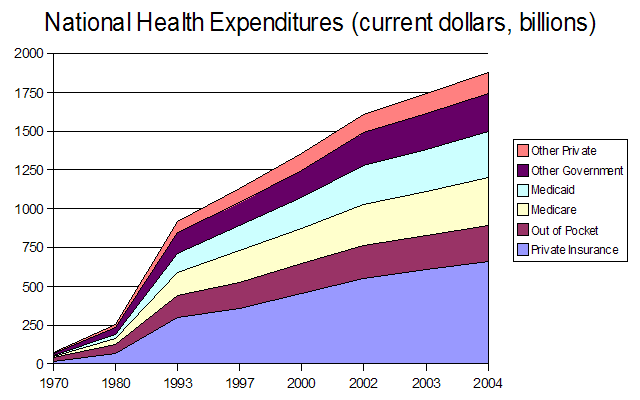
A piechart from this article shows that constantly rising health care costs are mostly due to hospital care (31%). Physician services are the next largest item, comprising one-fifth of the national health spending. Prescription drugs, while accounting for only 10% of total expenditures, have been the fastest-growing segment along with new medical technologies that are often not cost-effective, and provide incremental improvement or just an illusion for consumers that they are better taken care of. Second major contributor to the increase in spending is chronic disease. It actually accounts for 75% of national health expenditures. One of the main reasons for increased disease prevalence is an increase in unhealthy lifestyles. Obesity-related illnesses accounted for 27 percent of the real health care expenditure increase between 1987 and 2001, of which increased obesity prevalence accounted for 12 percent. Non-obesity food-related illnesses are at fault too. Aging of the population also contributes (although rather minimally) to the high growth rate of health care spending. Administrative costs comprise 7% of health care expenditures (~2% Medicare program).
"Health care is expensive because of the pervasive entitlement attitude" Joseph R. Antos, the William H. Taylor scholar in heath care and retirement policy at American Enterprise Institute.
"Insurers, pharmaceutical companies, device manufacturers, doctors and hospitals are all able to drive up prices with limited pushback" Jacob S. Hacker, the Stanley B. Resor professor of political science at Yale University.
"People often do not have control over medical expenses, the way they can control expenses when buying a car"
"Another reason normal market forces fail in the health care system is a lack of clear information. Purchasing health care is not like buying a car.", "the price tag is rarely even discussed", "people often do not have control over medical expenses",
David M. Herzenhorn
"The costs of medical care are a hodgepodge of different prices for different patients", "There is no rational process for selecting a cost-effective treatment", M Mackiernan
"How do I "negotiate" my fees when they are pre-set by my insurance company?", "I keep reading that doctors recommend unnecessary tests but how am I to know what's necessary? I'm not a doctor. I just want to feel better and that's why I go to the expert", E. Nowak
"Doctors and patients rarely know the costs and administrators do not want them to know.",
"Health insurance is not really insurance at all. It is more like a membership fee to a YMCA.", Marci Twain
"The most powerful way we can reduce medical costs is for people to stop getting medical care when non-medical health care will suffice.", Anonymous Commenter
"One element of the increasing cost is the vast overtesting that is performed in teaching hospitals.", "A large fraction of blood tests, procedures, and imaging are simply a waste, but there is no effort to put any brakes on the system.", David Freeman
"Please do not ever think a doctor writes a prescription because it is his best choice, it usually is written because he likes the pharmaceutical rep and she or he has treated the like a king.",
Mark Shryock
"New and fancy machines which offer marginal improvement in actual care but cost more.", PH
"What a mess. It makes me sick--a luxury I apparently cannot afford.", Elliot
"In essence the solution to cost control is in great part in the realm of industrial engineering. Lets get the industrial engineers on board and perhaps in charge.", Rafael Venegas
"The vast majority of xrays scans and tests performed are done to avoid malpractice. .. Americans are radiated so doctors can avoid the awful pressure of lawsuits and you pay for it..", Boly
"In some areas, like implantable medical devices, an increasing number of manufacturers contractually require hospitals to keep prices that hospitals pay secret from the surgeons who tell hospitals which products to buy.", Jeffrey Lerner
"The reason health care in the U.S. is so expensive is because all the players (doctors, lawyers, insurance companies, drug companies, medical equipment companies, patients, et al.) are abusing the system.", G. Stern
"I can't believe a five minute altrasound cost over 1,000 dollars", Linda
"Capitalist theory says that price is set at that point at which providers (suppliers) receive enough money to be induced to make the products and consumers (demanders) are willing to pay for that product. The problem is that the demand for health care is “relatively inelastic.”.. there is no limit on the will of the consumer to pay.", AF
Let me disagree with the last commenter, though. "Thank God", says AF, "I do not have to know the science behind to know the relative effectiveness rates of each type of treatment". A century ago nobody would imagine been able to make a phone call or operate a computer. May be people like to live too much. But better tools will be created to allow them make informed decisions to better their health and their lives at reasonable costs.
Everyday choices determine your health better than genomics. In addition to exciting gizmos and wearable monitors measuring activity, heart rate, sleep patterns, some companies are working on tiny implantable sensors helping to monitor health and health-related behaviors. Proteus Biomedical is implanting tiny sensors into pills that send signals translatable into messages - such as "just took lipitor at 6:20pm" - sent in a very safe and private way to a wearable plaster, or a smart-band aide. This smart plaster is also picking up information on health-related measurements such as your heart rate, breathing patterns, activity level, stress, respiration get sends you reminders. Last September Novartis worked with Proteus on a small 20 patient study to track patients’ compliance with their blood pressure drug regimen. This year the companies will work on sensor technology in organ transplantation.
American tech companies, taking notice of the unmistakable demographic trends, have launched a surge in gudgets for aging population - dubbed the silvertech. Emergency alert services have become a proliferating category in silvertech, along with sensor systems for the home, various kinds of long-distance health monitoring and smart medication dispensers that provide reminders and control dosage. Some dispensers signal a caregiver when a dose isn’t taken or a pharmacy when it’s time for a refill.
GE scientists are developing wearable RFID sensors to detect airborne chemical agents - to alert people to the presence of environmental chemical agents in the air. A novel technology based on resonant antenna structures of RFID sensors coated with various sensing films will recognize specific volatile organic compounds (VOCs) and chemical agents with part-per-billion detection limits. The sensor could also be used to analyze a person’s breath. Simply breathing on the sensor could potentially pick up biomarkers that serve as an early signal to the presence of certain diseases such as diabetes or cancer and metabolic disorders.
Teenagers love to spend, Health care consumers love to test.
Recent mammogram debate shows why reform will fail - most women don't like to get mammograms later in life and less frequently. Of course, this furious reaction is fueled by those who would face payment cuts if the new guidelines are implemented - radiologists, for example.
How many medical tests do you need to sleep sound at night knowing that you are healthy enough? Billions, trillions, googols? How many out of a few thousand existing medical tests are redundant or irrelevant to individual consumers?
Dr. Kevin Pho, an internist in Nashua, N.H., thinks the rebellion indicates a larger problem with ObamaCare. "The fact that [the administration] is distancing itself from what I consider to be very robust guidelines portends a very poor future for comparative effectiveness," he says. "If they back down now, what's going to happen when a comparative effectiveness body says there's no difference between angioplasty and medical management of heart disease?"
The American College of Obstetrics and Gynecology (ACOG) has just revised their guidelines for Pap smears under some pressure. This resulted from an Annals of Internal Medicine article which documented that only 16.4% of gynecologists followed the College’s prior guidelines. Most did more screenings than indicated, the worst record of the specialties tested. But the ACOG still recommends that nearly all women obtain regular screening at intervals of 1-3 years.
Cervical cancer is a rare disease in the US: just over 11,000 cases are predicted in 2009. There will be nearly as many cases of testicular cancer, 8,400. In comparison both breast and prostate cancer are just under 200,000. Most women have been led to believe that cervical cancer is rampant and they need yearly screening to prevent it. Testicular cancer however, is rarely mentioned. Most physicians don’t even bother to recommend that young men self-examine.
Medicine is as much art as science – there are many cases where there are no “right” answers. Health care providers can prescribe as many procedures as they want and charge whatever they like. It's time for this to be changed.
Personal risk of cervical cancer, for example, can be easily estimated by every woman as it depends on whether she had multiple sexual partners, prior negative Paps, long term mutually monogamous relationship. HIV (that has a five times greater incidence than cervical cancer) tests are not administered to people without risks, right? Well, not quite right, but that's another story.
Dr. Joel Sherman (Medical Privacy, A Patient Oriented Discussion) has seen many women who are angry that the facts on cervical cancer have been hidden from them. They are pushed into getting Paps, but never told the pros and cons of screening. Never mentioned are the high incidence of abnormalities that resolve spontaneously, like negative biopsies and colposcopies.
If the law says insurers have to treat every person the same, without taking into account whether they’re sick or healthy, young or old, a rational insurer will do some rational things. For example, it will assume disproportionate numbers of people who buy a policy from them will be sick and old. Of course, when they do this, the product becomes expensive, and young, healthy people start to wonder if they should even buy it in the first place. After all, they don’t really need insurance, right? Coupled with the overall rise in the cost of health care, insurers now push through new rounds of price increases, which, in turn, create more uninsured people. It is a very nasty cycle.
We need to change the way health care is envisioned, organized and delivered. We need creative approaches to building novel business models, and "disruptive technologies" to shake up the current system.
The reform should create a different culture among health care professionals. Solutions include retail clinics that let people pay cash for low-end services and care, new primary care models such as Qliance, MDVIP, QuickHealth, and 1Life, clinics staffed largely by non-physicians, divorcing of physician payments from volume of services, more electronic encounters between doctors and patients and more automation.
Aurametrix works on automatic solutions beyond electronic medical records, for a healthier world.
Most people are interested in wellness for career more than in wellness for body, in healthy looks more than in health, in holistic medicine and changing lifestyle more than in drugs, in social advice more than in a physician’s advice. What about you?


![Reblog this post [with Zemanta]](https://lh3.googleusercontent.com/blogger_img_proxy/AEn0k_vJXIcS84zjO7vY9UCm-5uZwIXaPhNSAW91IQCPU258jlh-ghQVVL-UPAf6WKnMrOj2rh7qxmNKlDY_de0YNsfIsMUVzt3q0i_M2G0RjR-taWFl47bZPfB7zViX9fVv0-2YQs0VME5qr7zdpmtApQU6=s0-d)


![Reblog this post [with Zemanta]](https://lh3.googleusercontent.com/blogger_img_proxy/AEn0k_t23X3jyyl-cXPbAo1Y8gGF0XBuYQoBJHHkgHnt8frZBPHxt08dOYwgy08mSllDT-DW8oVmLaA2J-vhHyN3fFIopSddLWQPBDyZIIZCut2KztTAKy_bV9qD3AwYZcSgj31HK_Kw665fvFTH6MHK-u1q=s0-d)


![Reblog this post [with Zemanta]](https://lh3.googleusercontent.com/blogger_img_proxy/AEn0k_sBoS20C0nW7G7Ki3XMvLDl5BuDBUqRRJFngWfQ2HP0iQbCPETJPSAm1JLS6mG_1mwuWKGiCFKKLmyGCV9KO3EZCcyazLVEbY8ao-d25NiuL0_G5i3cQesxdDZlFAzFaVFtXlQ3m27GGeAHpnfvl5g=s0-d)
![Reblog this post [with Zemanta]](https://lh3.googleusercontent.com/blogger_img_proxy/AEn0k_tlUwC3xtjZvt9c3HAzEEgFWMVvOy_R2s5iKibwtEqtU_8PFmCdnVD37QEfPsIwr45A9dIRsfij73HUXnEh-zslmBpfbMtNIIEqBRZKHdLes9MfEchW9e2hZrVOPm5d1NGNX4V8jHpRSsHOn5aCpEA=s0-d)
![Reblog this post [with Zemanta]](https://lh3.googleusercontent.com/blogger_img_proxy/AEn0k_u1ZG0kKIlV-cYL4942dPBcmHT-7lsdRpIxT4O9-Lel6eEYuNv3Sil1-LOOsBco8q-0zy1giUKQeRpdty7Xt2fzw1pP0X4AYvJ10UtytQmDqYY-FgMn02xz_tY4W3X6KD3H3RBm9uKnFY3t4-7gaYE=s0-d)

![Reblog this post [with Zemanta]](https://lh3.googleusercontent.com/blogger_img_proxy/AEn0k_v6tKU7wXyRdg97emG6GwuNmqoIMHxy7L1Bua8u8UcF80lomm4EqjkQy7gTDk8EPRe74Et8aQKYvZdYtiPkg7bKGani5wiS-LtK-Fx3_3fMg0jCJf9AGNJwCJyEYB0isznzbhFjG3lnXKkbPBBcdzgM=s0-d)


![Reblog this post [with Zemanta]](https://lh3.googleusercontent.com/blogger_img_proxy/AEn0k_sB3kOd4rQo4yWA4FX5mkpMWgPstvHlMOvSVwkRuKr04njMNiaJ96QYUgVZxJtgPi-LGfmMPWadNqNgQAu85gvL2OIomlfIEHMDhaqPrJgShD44qVUU1QhCO_gWZB_TsLtpaPPiowSm26DLcz6l2FE=s0-d)