Showing posts with label Health care. Show all posts

Wednesday, October 8, 2025

The Case History (In Nine Circles)

In a small provincial kingdom — which, for diplomatic reasons, I shall call The Hospital of Virtum — there lived a lady of eighty-some years: intelligent, sharp-tongued, and weary of her own body. Her heart no longer kept time; her legs sang hymns of pain day and night.

A vascular surgeon, learned and distinguished, examined those legs as though they were chapters in an old, dog-eared book. He sighed and said,

“This requires a team the size of an orchestra.”

But the orchestra was on tour — indefinitely — so he prescribed two instruments instead: antibiotics and morphine.

The lady was of the old school.

“I’ve lived long enough to know what kills me,”
she said, shaking her head at the powders and elixirs of the modern age.

After much persuasion came antibiotics and probiotics, soups of virtue, kefir consultations — and yet the pain stayed. So the second remedy was tried: the opioid Hemamorphane, a word that might have escaped from Dante’s descent itself. Still, no relief. The legs burned as before.

By Sunday evening, the pain had become a symphony of torment. Her heart danced arrhythmically; her blood pressure soared like an opera soprano. At last, an ambulance was summoned — and arrived in the form of two very young angels in polyester uniforms, still fragrant with the smell of textbooks. They performed their EKG, boarded her ceremoniously, and whisked her away.

Inside, the air was infernal. The caregiver fumed; the patient moaned.
It was the Fifth Circle — wrath and despair, both boiling in the same cramped river.

They reached the Emergency Department, where time flows differently — slowly, cruelly. The nurse suggested more painkillers. The lady refused.

“I want to understand the cause,” she insisted. “Perhaps there are clots.”

The nurses exchanged a look.
Cause? In this kingdom, causes are mythical beasts — rarely seen, never captured.

So they rolled her into the waiting room, sat her in a wheelchair designed by medieval torturers, and left her under the flicker of fluorescent light. Around her gathered the other souls of Limbo: a girl with sepsis, her mask pale against the blue light of her phone; two teenagers scrolling through pain.

Then came the receptionist, guardian of the Second Circle.

“You must pay,” she said, “before any service.”

The caregiver paid. She was also given half a forest of forms to sign — unreadable, urgent, and perhaps binding her soul. She signed anyway. The lady’s face was white, her legs swollen like bread dough left too long in the sun.

Hours slipped by.

The chair was unkind. The lighting, penitential. After much pleading, an orderly adjusted her footrest by two centimeters - a gesture toward mercy, if not toward Paradise.

When she asked for a bathroom, both were locked — relics of a more civilized age.

And so they lingered — between the Third and Fourth Circles of our modern Inferno: Bureaucracy and Indifference.

And as the caregiver looked at the suffering patient, she thought: “If Dante were alive today, he would need a Triage Department for the damned.”

The caregiver’s patience cracked. She made a speech. The sepsis girl joined her in chorus, a duet of despair. At last, the guardians of this realm took pity - or offense - and moved them to separate waiting rooms. The new chair was softer and a bathroom available.

Progress.

Then came blood tests, then more waiting.
Morning brought results: D-dimer high. Suspicion of clots. An ultrasound was ordered. But there was a line — always a line.

“Don’t call us,” said the clerk. “We will call you.”

The caregiver called anyway. By midday, they were summoned back — through a labyrinth of nurses, numbers, and barcodes. Payment required, but cash and cards not accepted. The caregiver, bent over her phone, tapped through endless screens until at last a barcode appeared — salvation by QR code.

After two more offices and an hour of silence, their number flashed — then vanished.

“The team went on break,”
said the receptionist, tearing the ticket.
“You’ll need to take another number.”

At last, an ultrasound. The machine was ancient, its sound like bones grinding. The technician pressed hard — pain seared through the leg.

“No clots,” she announced.
“What about the other leg?”
“We only do one at a time,” came the reply.

Back to the nurse. More waiting. She smiled kindly but said,

“I can’t show you the results. I’d go to jail.”

Such is the law of Virtum.

Back to the ER. More forms, more indifference. Finally, a doctor — harried, hollow-eyed — arrived.

“Just take Tylenol,” he said.
Then, to the caregiver:
“Maybe it’s heart failure. What else do you want?”

And so they were discharged — the patient in more pain than when she entered, the caregiver in despair.

How long could she endure?
No one could say.


Epilogue

Let us note, for the record, that the illness of our time is not only in arteries or veins.
It is in the system itself — a moral arteriosclerosis that clogs compassion and chokes the flow of sense.

Around the world, the same symptoms appear.

In New York, twenty-year-old Sam Terblanche died after two visits to Mount Sinai Morningside. Diagnosed twice with “a viral syndrome,” he was sent home. Days later, he was found dead. The autopsy revealed pulmonary hemorrhage of unknown cause. Experts suspected sepsis, or a post-COVID autoimmune storm. None could say for sure. What’s certain is this: the system missed him.

In Winnipeg, Chad Christopher Giffin waited eight hours in the ER — and never made it out.
In Quebec, Adam Burgoyne, 39, was told he wasn’t “dying” — and left after six hours, only to die the next day.
In Italy, Cristina Pagliarulo perished after forty hours in a Pronto Soccorso.
In Ontario, sixteen-year-old Finlay van der Werken, bright and kind, died after an ER visit that should have saved him.

Different nations, same pathology.

The modern hospital has become a paradox — a place meant for healing that too often serves as a sorting center for the living and the nearly dead. The causes are known:

  1. Overstretched emergency rooms — overcrowded, understaffed, forced to “move the meat.”

  2. Diagnostic haste — rare, lethal cases lost amid the ordinary.

  3. Electronic record tyranny — notes for billing, not understanding.

  4. Fragmented accountability — no one person responsible, everyone “following protocol.”

  5. Cognitive bias — young and old alike dismissed because they don’t “look sick.”

  6. No continuity after discharge — once you leave, you vanish from the system.

  7. And towering above it all: administration - endless layers of approval, offices feeding offices, a machine designed to protect itself, not patients.


Transparency has evaporated — in places like Canada, you may not even be allowed to see your own test results. The system hides what it should reveal, and delays what it should decide.

Meanwhile, outside the hospital walls, people are already turning to tools that can do in minutes what bureaucracy and burnout stretch into weeks - AI systems that see patterns, synthesize, and recall what no overworked clinician has time to. 

The Hospital of Virtum is not a fantasy. It is everywhere - New York, Winnipeg, Milan, Montreal, Toronto.

The cure? Not another protocol. Not another app.

What’s needed is time, staff, accountability, and the permission to care.
A culture where asking why is not seen as defiance.
Where a locked bathroom is not a metaphor for the entire institution.

Until then, the triage line is the new Inferno —
and the dead keep teaching the living what compassion once meant.


REFERENCES

https://www.nytimes.com/2025/10/05/well/sam-terblanche-virus-death-columbia.html

https://archive.is/MgWJH#selection-693.288-693.375

https://news.ycombinator.com/item?id=45487519

https://www.winnipegfreepress.com/breakingnews/2025/01/24/probe-into-death-of-man-in-hsc-waiting-room-weeks-from-completion

https://www.ctvnews.ca/montreal/article/this-montreal-man-died-of-an-aneurysm-after-waiting-in-the-er-for-six-hours/

https://en.cronachedellacampania.it/2025/09/Pagliarulo-case%3A-Cristina%27s-autopsy-could-have-been-saved-if-operated-on-in-time/

https://globalnews.ca/news/11296590/ontario-family-sues-hospital-staff-sons-death/

Wednesday, February 17, 2010

Inefficiencies of Health Care

Is healthcare cost control possible? Aurametrix addressed some unhealthy aspects of healthcare in other articles, but there is always more to add.
"Despite the rampant inefficiencies and extremely high costs of health care in the United States, it is still possible to make the American health care system even more inefficient and more costly", say Drs. Fodeman and Book in the Wallstreet Opinion journal. What really drives health care spending is it's inefficient structure and business model along with increasing prevalence of chronic disease. Health Care spending is often wasteful failing to improve health outcomes and not bringing any value to the patients. Health care providers seem to be able to charge whatever they like. Existing system insulates both patients and providers from normal market incentives to reduce prices and spending. We recommend to read this article as it provides more insight.

Or watch the video to better see what's wrong with our health care system.


Reblog this post [with Zemanta]

Thursday, January 14, 2010

Tele-Tracking and Remote Health Monitoring

gps-shoes-957Image by gaspar via Flickr


Medical Care Technologies Inc. (MDCE) today announced completion of version 5.1 of the Trackker(TM) technology for patients suffering with Alzheimer's and Dementia.
The Trackker and its Tele-Health Suite use wireless connections to link a GPS monitor that is worn by the patient and is linked to a 24/7 monitoring service. By programming the GPS to certain safety zones, the service can send a phone or email alert to a caregiver immediately. GPS systems (based on 24 satellites and their ground stations) typically track patients in open areas outside of buildings however, the Patient Tracker system has the ability to monitor the location of patients within and around facilities.
According to the Alzheimer's Disease International, in 2008 there were 30 million people with dementia worldwide. By 2050, it is projected that this figure will have increased to over 100 million and so will numbers of people with Alzheimer's disease. Much of the increase will be in developing countries, especially China, India, and their south Asian and western Pacific neighbours.

Many other remote monitoring systems are commercially available (See, for example, GPS shoes that let mommy know where kids are) Among silvertech offerings, Japanese conglomerate Marubeni’s technology seems to be particularly advanced.

Developed by the Advanced Institute of Wearable Environmental Information Networks, the sensor intended to be worn on the chest measures just 3×3cm and is 5mm thick. Vital signs such as body temperature or heart rate can be monitored remotely and analyzed using special software.

Acciordign to The Nikkei, sensors cost around $350 each, while Marubeni charges $110 monthly for using the software. The company aims at generating $11 million in sales in the first year with the system.

And you may even not wear anything at all in order to be monitored - if you have a tiny chip implanted under your skin. Formerly known as VeriChip, PositiveID ( SVUL) is beginning a study of its Health Link implantable microchip in diabetic, hypertensive and obese patients. The implanted chip can be scanned to access the patient’s online medical records, check glucose and cholesterol levels (see HealthScreenDirect) and is expected to improve disease management. The company’s critics fear the chip will one day become mandatory, leading to a complete loss of medical privacy and healthcare benefits. Credit and Health monitoring may be even integrated. Google and Microsoft are said to be among those possibly testing the chips.

================================================================
This is a continuation of telemedicine/wireless health series by Aurametrix. Previous blogs included Telemedicine: part 1; Telemedicine: part 2; survey of Health 2.0 Software tools, Devices to keep you healthy; Going for the piece of a healthcare pie; On M-Health, wireless health and smart plasters.
Reblog this post [with Zemanta]

Wednesday, January 13, 2010

Counting Health Care Costs

Is control of health care costs possible?

A piechart from this article shows that constantly rising health care costs are mostly due to hospital care (31%). Physician services are the next largest item, comprising one-fifth of the national health spending. Prescription drugs, while accounting for only 10% of total expenditures, have been the fastest-growing segment along with new medical technologies that are often not cost-effective, and provide incremental improvement or just an illusion for consumers that they are better taken care of. Second major contributor to the increase in spending is chronic disease. It actually accounts for 75% of national health expenditures. One of the main reasons for increased disease prevalence is an increase in unhealthy lifestyles. Obesity-related illnesses accounted for 27 percent of the real health care expenditure increase between 1987 and 2001, of which increased obesity prevalence accounted for 12 percent. Non-obesity food-related illnesses are at fault too. Aging of the population also contributes (although rather minimally) to the high growth rate of health care spending. Administrative costs comprise 7% of health care expenditures (~2% Medicare program).

So the primary cost is unnecessary complexity. We need to change the culture of medicine, it's business model to improve the efficiency in delivering care and reduce the cost resulting from the wrong model.

An excellent blog in New York Times yet again explains the reasons on why health care costs so much. Great comments from the readers provide even more insight.

Here are a few excerpts we can't agree more:

"Health care is expensive because of the pervasive entitlement attitude" Joseph R. Antos, the William H. Taylor scholar in heath care and retirement policy at American Enterprise Institute.

"Insurers, pharmaceutical companies, device manufacturers, doctors and hospitals are all able to drive up prices with limited pushback" Jacob S. Hacker, the Stanley B. Resor professor of political science at Yale University.

"People often do not have control over medical expenses, the way they can control expenses when buying a car"
"Another reason normal market forces fail in the health care system is a lack of clear information. Purchasing health care is not like buying a car.", "the price tag is rarely even discussed", "people often do not have control over medical expenses",
David M. Herzenhorn

"The costs of medical care are a hodgepodge of different prices for different patients", "There is no rational process for selecting a cost-effective treatment", M Mackiernan

"How do I "negotiate" my fees when they are pre-set by my insurance company?", "I keep reading that doctors recommend unnecessary tests but how am I to know what's necessary? I'm not a doctor. I just want to feel better and that's why I go to the expert", E. Nowak

"Doctors and patients rarely know the costs and administrators do not want them to know.",
"Health insurance is not really insurance at all. It is more like a membership fee to a YMCA.", Marci Twain

"The most powerful way we can reduce medical costs is for people to stop getting medical care when non-medical health care will suffice.", Anonymous Commenter

"One element of the increasing cost is the vast overtesting that is performed in teaching hospitals.", "A large fraction of blood tests, procedures, and imaging are simply a waste, but there is no effort to put any brakes on the system.", David Freeman

"Please do not ever think a doctor writes a prescription because it is his best choice, it usually is written because he likes the pharmaceutical rep and she or he has treated the like a king.",
Mark Shryock

"New and fancy machines which offer marginal improvement in actual care but cost more.", PH

"What a mess. It makes me sick--a luxury I apparently cannot afford.", Elliot

"In essence the solution to cost control is in great part in the realm of industrial engineering. Lets get the industrial engineers on board and perhaps in charge.", Rafael Venegas

"The vast majority of xrays scans and tests performed are done to avoid malpractice. .. Americans are radiated so doctors can avoid the awful pressure of lawsuits and you pay for it..", Boly

"In some areas, like implantable medical devices, an increasing number of manufacturers contractually require hospitals to keep prices that hospitals pay secret from the surgeons who tell hospitals which products to buy.", Jeffrey Lerner

"The reason health care in the U.S. is so expensive is because all the players (doctors, lawyers, insurance companies, drug companies, medical equipment companies, patients, et al.) are abusing the system.", G. Stern

"I can't believe a five minute altrasound cost over 1,000 dollars", Linda

"Capitalist theory says that price is set at that point at which providers (suppliers) receive enough money to be induced to make the products and consumers (demanders) are willing to pay for that product. The problem is that the demand for health care is “relatively inelastic.”.. there is no limit on the will of the consumer to pay.", AF

Let me disagree with the last commenter, though. "Thank God", says AF, "I do not have to know the science behind to know the relative effectiveness rates of each type of treatment". A century ago nobody would imagine been able to make a phone call or operate a computer. May be people like to live too much. But better tools will be created to allow them make informed decisions to better their health and their lives at reasonable costs.


Aurametrix is developing decision support systems to help you evaluate personal health risks, decide on preventative measures, estimate cost/benefits of performing diagnostic tests. Better solutions for a healthier world.
Reblog this post [with Zemanta]

Sunday, January 3, 2010

On M-Health, Wireless Health and Smart Plasters

M-health or mobile health is a recent term for mobile devices supporting medical practice. This term is closely related to Telemedicine (coined in the 1970s) and to another recently introduced term wireless health.
Mobile phone subscribers per 100 inhabitants 1...
Aurametrix wrote about exciting health gadgets and devices in several last year's blogs (such as Telemedicine: part 1, Telemedicine: part 2, Devices to keep you healthy, Going for the piece of a healthcare pie)

Many companies - large and small -make use of wireless sensors to collect clinically-actionable data for point-of-care. Companies including GE, Cinterion, Cardionet, Heatlhsmart, Digi, RIM, Proteus, E-Device, MedApps, are now working in mobile health area offering products and developing prototypes. Check, for example T+ Medical, Turkcell's Saglik365, Orange's Diabeo, Telstra's My-Glucose, Cardionet's MCOT™, and numerous cell phone applications (as some people say, the Phone will become your doctor) such as Allscripts remote. And there will be many more exciting developments - portable wearable devices scanning brain for signs of depression & stress disorders,

Everyday choices determine your health better than genomics. In addition to exciting gizmos and wearable monitors measuring activity, heart rate, sleep patterns, some companies are working on tiny implantable sensors helping to monitor health and health-related behaviors.
Proteus Biomedical is implanting tiny sensors into pills that send signals translatable into messages - such as "just took lipitor at 6:20pm" - sent in a very safe and private way to a wearable plaster, or a smart-band aide. This smart plaster is also picking up information on health-related measurements such as your heart rate, breathing patterns, activity level, stress, respiration
get sends you reminders. Last September Novartis worked with Proteus on a small 20 patient study to track patients’ compliance with their blood pressure drug regimen. This year the companies will work on sensor technology in organ transplantation.


American tech companies, taking notice of the unmistakable demographic trends, have launched a surge in gudgets for aging population - dubbed the silvertech. Emergency alert services have become a proliferating category in silvertech, along with sensor systems for the home, various kinds of long-distance health monitoring and smart medication dispensers that provide reminders and control dosage. Some dispensers signal a caregiver when a dose isn’t taken or a pharmacy when it’s time for a refill.

GE scientists are developing wearable RFID sensors to detect airborne chemical agents - to alert people to the presence of environmental chemical agents in the air. A novel technology based on resonant antenna structures of RFID sensors coated with various sensing films will recognize specific volatile organic compounds (VOCs) and chemical agents with part-per-billion detection limits. The sensor could also be used to analyze a person’s breath. Simply breathing on the sensor could potentially pick up biomarkers that serve as an early signal to the presence of certain diseases such as diabetes or cancer and metabolic disorders.


Reblog this post [with Zemanta]

Monday, November 30, 2009

Wednesday, July 15, 2009

Changing Culture of Medicine

by Aurametrix

Healthcare is the largest service industry in the world. Its old ways don't work anymore.
One of the reasons is that medical profession is seen increasingly in financial terms. Can you separate the businessman from the doctor? Not in American Medicine, says Kevin Pho, MD, author of the web's leading physician blog.

We need to change the way health care is envisioned, organized and delivered. We need creative approaches to building novel business models, and "disruptive technologies" to shake up the current system.

The current model motivates doctors to think about diagnostic tests based on available technologies and profit, not the need. They will, indeed, order a heart-stress test when the nuclear camera is in the next room, diagnose and treat harmless cancers, and be under financial pressure to see as many patients as possible.

The reform should create a different culture among health care professionals. Solutions include retail clinics that let people pay cash for low-end services and care, new primary care models such as Qliance, MDVIP, QuickHealth, and 1Life, clinics staffed largely by non-physicians, divorcing of physician payments from volume of services, more electronic encounters between doctors and patients and more automation.

Aurametrix works on automatic solutions beyond electronic medical records, for a healthier world.
Reblog this post [with Zemanta]

Thursday, July 9, 2009

Sunday, May 31, 2009

From "Dr. Knows Best" to Health 4.0

The human brain provides inspiration for artif...Image via Wikipedia
Mirrored from Aurametrix Blog
What is Health 4.0? To answer this question, let’s take a look at the evolution of World Wide Web.
1st Generation Web, a.k.a internet before the bursting of the dot-com bubble, was a dial-up, 50K bandwidth, built around fixed content, with static pages and framesets providing one-way web of information.
Web 2.0 is usually associated with interactive information sharing, user generated content and the rebound of the Internet after dot com crash. It's "an average 1 megabit of bandwidth Web 3.0 will be 10 megabits of bandwidth all the time, which will be the full video Web, and that will feel like Web 3.0” says Netflix’ Reed Hastings . Everybody has a slightly different vision of generations 2.0, 3.0 and beyond.What are they? In a nutshell:
Web 1.0 “read-only”
Web 2.0 “read-write” (blogs, RSS feeds, tagging)
Web 3.0 “read-write-execute” (small apps with data in the cloud- as envisioned by google; a true communal media – citing yahoo; )
Web 4.0 when all of the above come together to form the learning self-aware Web, the era of artificial intelligence
According to by Tim O'Reilly', in the Web Squared everything and everyone in the world casts an "information shadow," an aura of data which, when captured and processed intelligently, offers extraordinary opportunity and mind bending implications. Web 3.0 will be some sort of virtual reality. If 1990-2004 was the match being struck; 2005-2009 was the fuse; and 2010 will be the explosion.
Web 1.0
Web 2.0
DoubleClick --> Google AdSense
Ofoto --> Flickr
Akamai --> BitTorrent
mp3.com --> Napster
Britannica Online --> Wikipedia
personal websites --> blogging
evite --> upcoming.org and EVDB
domain name speculation --> search engine optimization
page views --> cost per click
screen scraping --> web services
publishing --> participation
content management systems --> wikis
directories (taxonomy) --> tagging ("folksonomy")
stickiness --> syndication

We are now at the fork of Web 2.0 and Web 3.0, focusing on usability for humans and on internet architectures for machines. Some call web 3.0 a 3D game-environment web or a semantic web. Semantic Web was envisioned byTim Berners-Lee as a universal medium for data, information, and knowledge exchange easily understood by computers. Semantic technologies are already out there, for example, TrueKnowledge, Zemanta, newssift, wolframalpha, nextbio
Web 3.0 is a truly personalized web, a customized information delivery system tuned to your every want and need, whenever and wherever you are.
Analogous to the Generations of the Web, everybody is talking about Entrepreuneur 2.0, Women 2.0, DNA Sequencing Technologies 3.0… Business models for health care evolved from solution shops to facilitated networks, transforming the organization of health care delivery.
So, what is Health 4.0? According to this blog:
Health 1.0 = content
Health 2.0 = content + community
Health 3.0 = content + community + consumer-centric commerce
Health 4.0 = content + community + working commerce models + coherence
If that’s all it takes, Aurametrix is already building Health 4.0 technologies.
Health 2.0 is participatory medicine, says Web 2.0 evangelist Mark Scrimshire: Health 2.0 = (Me + MD)Us , where our relationship with medical doctors is enhanced by the community - all of us. Wikipedia definition of Health 2.0 (adopted from Hughes B, Joshi I, and Wareham J paper "Health 2.0 and Medicine 2.0: Tensions and Controversies in the Field" published in Journal of Medical Internet Research) is the use of a specific set of Web tools (such as blogs, tagging, search, wikis, etc) by actors in health care including doctors, patients, and scientists, using principles of open source and generation of content by users, and the power of networks in order to personalize health care, collaborate, and promote health education.
CHW Health blog gives the following definitions:
Health 1.0 Disenfranchised patients, a ”Dr. Knows Best” approach.
Health 2.0 The empowered consumer
Health 3.0. Personal responsibility becomes part of the social contract we all have with one another. Not only will consumers be given the tools and information they need to make better choices — they’ll be expected to do so. And there will be consequences for not doing so.
But consumer owned health care isn’t quite here yet, even though number of US Health 2.0 consumers is at 60 million. 10 million adults use their cell phones and PDA/smartphones to look up health and medical information, and “a growing number of patients are rating prescription drugs and treatments on sites like iGuard.org, DailyStrength.org, PatientsLikeMe, and WebMD.” Check out the top health web apps, Health 2.0 apps, the trends to watch in health 2.0, the latest industry stats and Health 2.0 updates by ReadWriteWeb.
We see Health 3.0 as truly personalized and highly coordinated health management services, customized diagnostics and expert advice... Just wait and see. You'll like it!
So, Long Live Health 2.0! Welcome Health 3.0! And let’s start thinking about generation 4.
Reblog this post [with Zemanta]

Monday, May 18, 2009

Transforming Healthcare: The Innovator's Prescription

I enjoyed reading "The Innovator’s Prescription: A Disruptive Solution for Healthcare" book by Clayton M. Christensen, Jerome H. Grossman and Jason Hwang, McGraw-Hill books, 2009.

I too think that Healthcare business model should be changed. The reform should focus on this to improve the quality of care and create a different culture among health care professionals.

The authors call for speeding up the process of building new health care models by allowing the market to work its magic: from ‘simplifying technologies’ to new networks and ‘value networks’.

Check out Clayton Christensen's SlideShare Presentation.

Reblog this post [with Zemanta]

Friday, May 8, 2009

Stress 2009

The health of the nation has declined mostly because of stress caused by job losses, money worries or increased workload. According to recent US and UK studies, more people are losing sleep, take antidepressants and live unhealthy lifestyles.

Mental stress spirals with economy, and costs economy.

A study by Harvard Public School published in the May 8 issue of Demography analyzed U.S. data on a wide range of occupations: managerial and professional positions; sales, clerical and craft jobs; machine operator jobs; and service positions.The likelihood of reporting fair or poor health increased by 54 percent among those who lost a job through workplace closure (similar across all occupations and positions). The odds of developing a new health condition rose by 83 percent among those who had no preexisting health problems. Job loss due to lay-offs, being fired or voluntary resignation more than doubled the likelihood of reporting fair or poor health among blue collar workers, but it had no effect on the health status of white collar workers.
Losing a job can lead not just to financial hardships but to health problems as well, including high blood pressure, diabetes, heart disease, heart attack and stroke.

Americans worry and struggle as economy worsens

“Where and how we live, work, learn and play have a greater impact on how healthy we are than the health care we receive,” David R. Williams, staff director of the Robert Wood Johnson Foundation Commission to Build a Healthier America and a Harvard professor, said in a news release.

Economy keeping many up at night. According to the 2009 Sleep in America poll by the National Sleep Foundation, out today, more than a quarter (27%) of Americans are losing sleep over financial worries.Young adults use more sleep aids, women are using more antidepressants & less estrogen.

Job stress can affect a person’s health as bad as smoking or a sedentary lifestyle can.

According to UK Insurance Daily News, the percentage of respondents admitting to being under a significant amount of stress increased from 38% to 40%.

Half of those surveyed agreed that stress is affecting their personal lives and 41% revealed that money worries were at the root of the condition, while 22% blamed an increased workload.

The problems of increased stress are exacerbated by a lack of exercise. According to PruHealth, the number of people reporting that they never exercise has increased from 11% to 14%, with more than a quarter (28%) of adults blaming work commitments.

Unemployment Rate Rises as Pace of Layoffs Slows. But hopefully the worst days are behind. Job stress has severe consequences, for us all and for the economy. Scotland's mental health improvement plan was launched today indicating that an understanding of the importance of protecting a person's own mental health could be key to reducing health problems. How people deal with stress greatly affects their well-being.

Stress can affect nearly every part of your body. So plump up your pillows, get more sleep, exercise and stop worrying.

Reblog this post [with Zemanta]

Thursday, May 7, 2009

Telemedicine 2.0, part 1


by Aurametrix

The term telemedicine was coined in the 1970s by Thomas Bird. The origins of this technology date back to smoke signals in ancient times. Earliest electroni devices included STARPAHC - a van staffed by two paramedics with a variety of medical instruments including electrocardiograph and x-ray. ATS-1, the first Applied Technology Satellite was in use in 1971-1975 to provide rural health care in Alaska. Minimal television system for remote diagnosis was developed in early 70s. Applications of telemedicine in early 2000s included remote consultation and diagnosis, specialty clinical care (anesthesia, dermatology, dentistry, cardiology, psychiatry, radiology, critical care, oncology, etc), patient education, home monitoring, and continuing education.
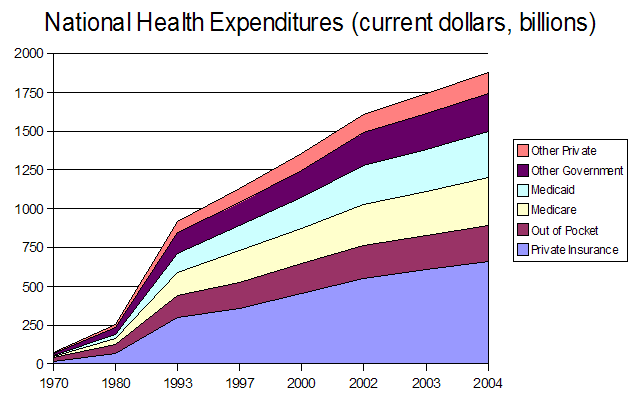
The health care cost is rising each year, it's already 16%-17% of the GDP. Wide utilization of wireless communications can reduce the health care cost by billions of dollars on an annual basis. Here are some examples of new developments.
Cisco HealthPresence combines state-of-the-art video, audio, and medical information to create an environment similar to what most people experience when they visit their doctor or health specialist. First Cisco HealthPresence booth was installed in January 2008.

Another California company, CardioNet provides the next-generation ambulatory cardiac monitoring service with beat-to-beat, real time analysis, automatic arrhythmia detection and wireless ECG transmission.

A startup in Redwood city, CA, works on
ingestible technology: microchip-enabled medications that provide patients with valuable information to customize their therapy. Proteus’s implantable ChipSkin™ technology adds tiny active electronics to devices that use electrical energy to deliver therapy inside the body. Similar technologies are being proposed (like a medication reminder watch by a UCLA student and the MedTracker device) or developed.

If you experience unpleasant gastrointestinal symptoms, such as abdominal pain, diarrhea, bleeding, anemia or GERD, you may be tested by capsule endoscopy with PillCam® family of products from Given Imaging. Vitamin-sized capsules with miniature video cameras inside will send pictures of your GI tract to a computer for your doctor to review. For GERD diagnosis, BRAVO pH monitoring system could be most useful.
Swallowable devices such Radio pill tocan monitor players temperature . Researchers are planning larger volunteer testing events this year.

This gadget is displaying your identification card, if you need it, Wireless Smart Badge, but is also a Bluetooth headset device and has the features of other wireless headsets. With up to 40 hours of talk time on a full charge, the Smart Badge by Iqua is easy to carry and use, is stylish and smart. Its standby time is up to 600 hours, it vibrates to alert incoming calls silently during meetings and allows 3-way conference calls.
It also has LED lights displaying Bluetooth connection, call status, and low battery indication. With supporting cell phones, this badge also allows for voice activated dialing. For full features and specification, you may find the Pdf of the product brochure here.

To be continued.

Aurametrix is working on tools to help you evaluate your personal health risks and benefits and make the right choices.


Reblog this post [with Zemanta]

Saturday, April 18, 2009

Selected Health and Wellness Polls

.....................................................................................................................................................................
@AurametrixMost people are interested in wellness for career more than in wellness for body, in healthy looks more than in health, in holistic medicine and changing lifestyle more than in drugs, in social advice more than in a physician’s advice. What about you?


SOCIAL NETWORKS
Does social media have a greater impact in patient's health practise compared to the physician advice?

See results: http://twtpoll.com/r/1639wo

By anonymous | Twtpoll created more than 3 months ago


HEALTH & WELLNESS

See results: http://twtpoll.com/r/9986lp

By @cateked | Twtpoll created more than 3 months ago


See results: http://twtpoll.com/r/sk27e8

By @RichHealth | Twtpoll created more than 2 months ago


PERSONAL HEALTH RECORDS

See results: http://twtpoll.com/r/nf3x7e

By @nyhto | Twtpoll created more than 4 months ago


See results: http://twtpoll.com/r/835nya

By @worldmedcard | Twtpoll created more than 4 months ago


See results: http://twtpoll.com/r/4wrdxl

By @marketintellnow | Twtpoll created more than 4 months ago


See all Health polls See all Diet and Fitness Polls

How do you record your workouts and eats?
  • Digitally: Online, iPhone apps, Blackberry...the higher the tech the better!
  • Pen and paper: It's cheap. It's easy. It works.
  • A combo of both: I'm multi-talented when it comes to documentation.
  • Brain: It's all up here [point to head].
Created on Mar 28, 2009 View Results


  • Yes and I go all the time
  • Yes but I only go sometimes
  • Yes but I go rarely
  • No but I wish I did
  • No but I sometimes consider it
  • No; I find it completely unnecessary
  • Some other answer Fig didn't think of
Created on Apr 13, 2009 View Results
  • Yes
  • No
  • Sometimes
Created on Mar 24, 2009 View Results

  • Omega-3’s up the optimism
  • Vitamin D: Sunshine in a bottle
  • Vegan chocolate cheesecake
Created on Jan 25, 2009 View Results
  • Yes. Whether it's in miles per week, weight lifted or weight lost, I set it and don't forget it.
  • Yes. I don't fret about numbers, but I always have "eat better" and "get more fit" on my to-do list.
  • No. I find that I work out whether or not I'm trying to meet a specific goal.
  • No. I don't set goals or work out. Eek! Maybe that's the problem!
Created on Mar 22, 2009 View Results

  • Breasts
    21%
  • Tummy
    42%
  • Thighs
    7%
  • Hips
    14%
  • Bum/Butt
    0%
  • Feet
    0%
  • Arms
    7%
  • Back
    7%
Created on Jan 1, 2008

Closed, Total Votes: 14

  • Morning - I sing the Sound of Music as I run laps in my nun's habit
    36%
  • Afternoon - I pump iron and watch Oprah. What?!
    13%
  • Evening - Gotta sweat off that dirty feeling my job leaves me with
    32%
  • All the time - I'm a compulsive exerciser
    8%
  • Exercise? I just read this blog for the pictures
    8%
Created on Dec 15, 2008

Closed, Total Votes: 172

  • It's all about my health and how I feel, love handles be darned
    5%
  • It's for my looks and why is that a bad thing?
    8%
  • Yeah, I say it's primarily about my health but I love that it makes me look better too.
    34%
  • It's mostly about my looks - the health benefits are just an added bonus.
    30%
  • I'm an exercise addict so whatever. Just move out of the way of my fan already!
    8%
  • How did we get off topic? Shouldn't we be lambasting Men's Health for their rampant misogyny??
    5%
  • I'm a man & I'd just like to say your dryer analogy is lame. I'll leave a better one in the comment
    6%
Created on Jan 28, 2009

Closed, Total Votes: 741


Aurametrix is working on personal health management systems, for a healthier world

Reblog this post [with Zemanta]
blockquote { margin:1em 20px; background: #dfdfdf; padding: 8px 8px 8px 8px; font-style: italic; }