Showing posts with label smart home. Show all posts

Thursday, January 11, 2024

Smart Homes Redefined

The concept of a smart home has evolved significantly, with technologies now focusing on health monitoring. The integration of advanced sensors and devices into our living spaces promises not only convenience but also proactive health management. 

While sensors placed throughout the home can detect air and water contaminants, allergens, and pollutants, high-resolution cameras and microphones and other non-contact measurement devices could allow health monitoring and remote consultations with healthcare professionals. 

Smart mirrors in bathrooms should transcend mere reflective surfaces. Enhanced with advanced computer vision capabilities, they could assess skin conditions, identify changes in appearance, and offer personalized health and beauty recommendations. They could also analyze the eyes for early signs of various health conditions, extending far beyond mere glaucoma and cataract detection. The eyes can unveil valuable information about cholesterol levels, liver conditions, and diabetes. Eye monitoring technology is a testament to the saying, "The eye is the window to the soul," extending its truth to health monitoring.

Ambient sensors equipped with radar technology in living rooms and bedrooms can continuously monitor vital signs like pulse rates. This non-intrusive monitoring could provide a seamless health tracking experience for residents.

Recent advancements include the use of mmWave radar sensors for continuous monitoring of human activity. Recently built system, utilizing an NVIDIA Jetson Nano board for real-time processing and a Texas Instruments Millimeter-Wave Radar Sensor, offers a non-intrusive and privacy-respecting way to monitor activities like sitting, walking, standing, and even detecting falls. This radar technology poses a challenge due to the high-dimensional point cloud data it generates. The PointNet neural network is developed to process this data efficiently, preserving spatial relationships and offering accurate activity classification. 

The traditional method of measuring SpO2 involves contact sensors, which can be inconvenient for prolonged use. New techniques for contactless SpO2 measurement using different light wavelengths in video images are being developed. This approach promises a more comfortable and accessible way to monitor oxygen saturation levels, especially crucial in the wake of health crises like COVID-19.

The COVID-19 pandemic has underscored the importance of non-intrusive health monitoring, especially for elderly individuals. The development of a Multi-scaled Long Short Term Memory (Ms-LSTM) model, as part of a smart toilet system, represents a significant step in this direction. This model enables effective home-based health diagnostics through urine analysis, leveraging the IoT-Fog-Cloud paradigm. It's a particularly vital tool for early detection of potential viral infections, including COVID-19, in the elderly. The Ms-LSTM model integrates a four-layered architecture including data acquisition, fog layer (processing and analyzing the data locally) , cloud (for deeper analysis) and interface layer. The proposed system offers a non-invasive, efficient method for early disease detection and preventive health. 

The integration of health monitoring technologies into smart homes is transforming how we approach personal health. From environmental sensors to advanced radar and neural networks, these innovations promise a future where health management is seamlessly woven into our daily lives. As technology continues to advance, we can expect even more sophisticated health monitoring solutions to emerge, making proactive health care a tangible reality in the comfort of our homes.  


REFERENCES

Alhazmi AK, Alanazi MA, Alshehry AH, Alshahry SM, Jaszek J, Djukic C, Brown A, Jackson K, Chodavarapu VP. Intelligent Millimeter-Wave System for Human Activity Monitoring for Telemedicine. Sensors (Basel). 2024 Jan 2;24(1):268. doi: 10.3390/s24010268. PMID: 38203130.

Sasaki S, Sugita N, Terai T, Yoshizawa M. Non-Contact Measurement of Blood Oxygen Saturation Using Facial Video Without Reference Values. IEEE J Transl Eng Health Med. 2023 Sep 25;12:76-83. doi: 10.1109/JTEHM.2023.3318643. PMID: 38088997; PMCID: PMC10712673.

Kumar D, Sood SK, Rawat KS. Empowering elderly care with intelligent IoT-Driven smart toilets for home-based infectious health monitoring. Artif Intell Med. 2023 Oct;144:102666. doi: 10.1016/j.artmed.2023.102666. Epub 2023 Sep 20. PMID: 37783534.

Fatima H, Imran MA, Taha A, Mohjazi L. Internet of Mirrors for Connected Healthcare and Beauty: A Prospective Vision. arXiv preprint arXiv:2311.14734. 2023 Nov 21.

Friday, April 1, 2016

Technology, Dreams and April Fool's Jokes

At least once per year, and more is likely better, laughter is the best medicine.

Today is April Fool's Day, when everybody from school-age kids to technology companies tried to trick people into believing into jokes.

Yet, as Sigmund Freud suggested, jokes often expose unconscious desires. Perhaps the technologies listed below, too,  have a grain of our desires wrapped in a smile?

reproduced with permissions of Aurametrix

Technology keeps marching ahead. And the future gets smarter with the Internet of Things. Here are a few announcements made today, on April 1 2016. 

CONNECTED CAR

Picture
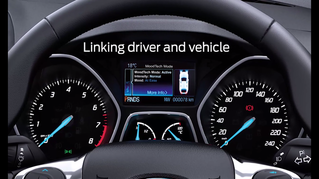
Ford Australia has announced new wearable technology connecting drivers to their car like never before. Based on ‘Mood-Ion Technology’, it would monitor a wearer’s body temperature and use cameras to track eye movement and feed this information into the vehicle. It is hard to foresee what exactlty the vehicle will do in response to driver's mood changes except powering lighting, but In selected Ford vehicles, there will be options to have the glove box retrofitted with a convection oven.

Lexus connects drivers and their cars too, using velcro adhesives to bond drivers to their V-LCRO seats.

​And so does the new LeisureVans app offering to experience the power of driving in a fully autonomous RV. Using the latest advancements in software and ultrasonic hardware, their engineers have perfected the future of the self-driving vehicle. Just download an app from the App store and let it control your self-driving leisure travel van. While driving, the app will suggest you to get some coffee or have a snooze, if you look too tired. It will also make the car to wash itself when needed.

And if you don't even want to think about cars while enjoying a drive, use Ola rooms, converting cabs into mini-hotels coming to your door step. The room will drive by the views you like and restaurants you prefer. Although you could use Deliveroo’s telepathic food order to make it easier. And pre-lick food photos to make sure you like what you are ordering. Or order Google Express parachutes if you want to have your lunch right away.  

VIRTUAL REALITY

Picture
​Google introduced Plastic Cardboard VR Headset proving that "the future is clear." "Google Cardboard Plastic combines everything you love about virtual reality headsets with everything you love about reality," the company said in a statement.
The goal is to make virtual reality feel more compelling, more immersed, make it feel like actual reality.

The innovative gadget allows users to view the world in 4 dimensions with 20/20 resolution and 360 degrees of sound  - assuming that's what is provided by your own senses. But if you prefer to trust other people's senses - try "Snoopavision," a 360-degree viewing experience with rapper Snoop Dogg. After all, "Dre has Beats, Jay has Tidal, Kanye has himself and now the world has Snoopavision," as says promotional video.

And if Virtual Reality still doesn’t seem real enough, ThinkGeek offers VR rig that could spray you with water, shoot stuff at you with a built-in projectile launcher, emit scent, and ticket you with cat arms if you so desire. 

SMART HOME

Picture
Wi-fi-enabled pillow Duolingo is making education more convenient by offering to  teach a language overnight. Thanks to synthetic fibers encouraging development in the cerebral cortex, high frequency sound system and a proprietary algorithm using Morse code to subtly teach the brain new language vocabulary and concepts in one's sleep.

There were more smart home announcements gimmicky enough to pass off as April fools jokes, but we won't be talking about them here. 

WEARABLES

Picture
If you're struggling to keep up with your New Year's resolutions, consider JOLT - new Electrotherapy Fitness Shoes from Soft Star Shoes. High voltage sensors in the JOLT's footbed deliver an electric shock whenever you stop moving, while patented Lace-Lock™ technology makes the shoes impossible to remove - taking fitness motivation aids to "stunning" new heights. 

Picture
We have certainly come a long way since the previous generation of wearables like Gluuv inspired by a Robocop movie (announced on April 1 2014 by HTC). The wearable could double as a self-defense device you’ll definitely want to have around if you ever find yourself in a Blade Runner-reminiscent décor.

Slightly less bulky Gloves announced by Samsung and Toshiba could use 25 appropriate fingergestures, replacing laptops, tablets, smartphones, fitness trackers, watches, glasses and any other future mobile innovation.

Perhaps we should come back to this later. 

Happy April Fool's Day!


References (in addition to those provided above)

Smith, Julian. "Apps for apes: Orang-utans want iPads for Christmas." New Scientist 212.2844 (2011): 69-71.

(2000). April Fool's Day and the Medicinal Value of Humor. The virtual mentor : VM, 2 (4) PMID: 23270623

Friedman, Joseph H. "APRIL FOOL'S COMMENTARY: IN PRAISE OF PLACEBOS." Medicine and Health Rhode Island 89.4 (2006): 124.

Redberg, R. (2015). The Prescription Is Laughter JAMA Internal Medicine, 175 (5) DOI: 10.1001/jamainternmed.2014.574

Robertson R (1984). Science and technology - dreams and reality. Journal of dental research, 63 (3), 371-3 PMID: 6583238

Tuesday, June 30, 2015

Technologies and Generations

Children no longer obey their parents and the end of the world is evidently approaching. So said a clay tablet inscribed almost 5 thousand years ago. But the world still stands, although we do go through golden and dark ages and societies rise and fall.

Technology's golden age is now, or so we hope. How are current generations influenced by it and how will they shape the future world?

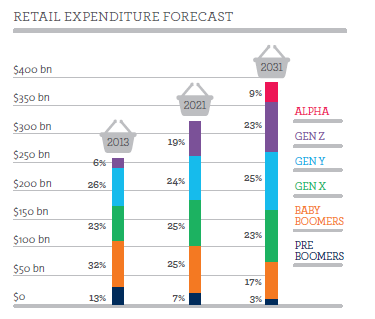
Even as they age, Baby Boomers embrace emerging technologies such as smartphones and social networking. They will be the driving and demanding force behind innovation in healthcare. In the past, they drove the economy by spending and borrowing, boosting housing and stock prices, increasing demand for products and services. 

America's neglected middle child, Generation X is now the quiet driving force behind enterprise, media and information consumption. Xers endured lots of destruction, but were able to adapt and sparked a renaissance of entrepreneurship. They bring to the table a significant amount of buying power, but are less eager to spend money. Nielsen poll suggests they prefer value over social acceptance.

Millennial Generation, alternatively dubbed the Net Generation, Generation Y (or Why?), Echo-boomers, Nexters, and Digital Natives is now the largest generation in U.S history. Fueled by immigration, they outgrew the outsized Baby Boomer population and continue to grow.  Raised on a steady diet of video games, in a world where almost everything can be done with an app, fanned by economic slowdown, they are choosing to live differently and embrace the sharing economySince the second world war, purchases of new cars and suburban houses have propelled economic recoveries. Millennials may have lost interest in both, spending on smartphones instead. "The cheapest generation" burdened by student loans is renting instead of buying. They are demanding better integration of technology into public services, prefer healthy, natural, socially and environmentally conscious products.

Perhaps auto brands and home builders just need to leverage mobile and environmental sustainability to attract this generation? Manufacturers do think so trying to turn cars into "giant docking stations with wheels". Tesla is one example of a brand adapting to millennials - and it's the top automotive stock owned by this generation. 

One-in-four Millennials (23%) already installed at least one of Internet-of-Things products in their homes, compared to 12% of the total population. But building a true "smart home" - like the one owned by the Jetson's  -  integrating and managing multiple devices, and dealing with their eminent malfunctions needs a lot of patience. Perhaps companies like IOTAS - creating smart homes for today's renters  - have taken the right first step? 

In the coming years, Millennials will continue to drive the growth in the Internet of Things, connected cars and wearable markets, and Generation Z will inherit technology rigorously tested by prior generations. What will be their signature product and communication device? We'll know soon enough.

Join our conference "The Rise of the Millennials – Emerging Disruptive Trends". It will take place on November 21st 2015, at the Intel Auditorium in Santa Clara. 


REFERENCES

Putre L (2013). The march of the Millenials. Your hospital staff in 2025: the same, only different. Hospitals & health networks / AHA, 87 (9) PMID: 24260968

G. Vouchilas, C. Ulasewicz,  (2014) The “Not so Young” Millennial Consumer  International Journal of Arts and Commerce Vol. 3 No. 5

Pew Research Group (2010) “Americans and their gadgets” (2010) 

Costanza, D., Badger, J., Fraser, R., Severt, J., & Gade, P. (2012). Generational Differences in Work-Related Attitudes: A Meta-analysis Journal of Business and Psychology, 27 (4), 375-394 DOI: 10.1007/s10869-012-9259-4 

Becton, J., Walker, H., & Jones-Farmer, A. (2014). Generational differences in workplace behavior Journal of Applied Social Psychology, 44 (3), 175-189 DOI: 10.1111/jasp.12208

Aschenbrener CA. (1998) The future is in the present: the impact of generations. J Am Coll Dent. 65(4):23-8. PMID: 9929986

Autotrader (2013) The Next Generation Car Buyer Millennials.

M.Fitzpatrick. (2013) Why I regret making my house a smart home

Saturday, September 6, 2014

Is the Internet of Things the Real Thing?

The Internet of Things: an exciting new world with a digital nervous system or a nightmare where objects take decisions while we are unconscious?

15 years ago, when the term was first coined, it was about assigning everything around us a unique identity with RFID tags, to enable all material things to talk to each other and save us time for gathering and using information. As RFID tags dropped below 1 cent cost, and sensors, modems and devices are getting smaller, smarter and cheaper, this vision is moving closer to reality.

The latest Gartner's Hype Cycle (August 2014) places the Internet of Things at the peak of Inflated Expectations, while Big Data evolving in tandem with IoT has already started to fall into the through of disillusionment, getting ready to join mobile health and cloud computing right there on the bottom of the through.


Consumers are not ready to embrace the flood of smart wearables and appliances - as they don't really know what to do with them, don't perceive their value and are concerned about privacy and prices.

Clay Christensen's theory of "disruptive technology" emphasizes that technologies tend to get better at a faster rate than users' needs increase. Next Big Thing often starts as an expensive "toy". When the telephone was first introduced it could only be afforded by the rich and it could only carry a signal over a short distance. If Watson really had said in 1943 that "there is a world market for maybe five computers", as Gordon Bell pointed out much later, it would have held true for some ten years.

The first generation of IoT devices fell short of user needs and was rather primitive. Over a third of people who bought a smart wearable abandoned it a few months later. Yet, the "new" has never been hotter. It seems a new wearable is launching every week and we are constantly waiting for something newer and better, hoping it will finally answer the question "what can we do now that we could not do before?"

However, the current generation of "smart things" is focused mostly on better designed hardware and higher-end consumers. Fashionable elegant-looking devices are supposed to make wearables more appealing and "design thinking" is one of today's hottest buzzwords. Withings Activité, Fitbit pendants from Tory Burch,  Yves Béhar's designed Vessyl, Diane Von Furstenberg's Google glass, Rebecca Minkoff's tech-enabled jewelry, and the new bracelet from Intel - MICA  - highlighted by pearls and other precious stones - are getting ready to conquer attention of consumers and developers. Especially developers - as the size of the market will depend on the number of developer-entrepreneurs creating value in it.

The app economy taught hardware manufacturers that when people experiment they find ways to create value, often in unexpected ways.  But it also taught developers that they need to invest considerable time to build a marketable app and the chances of that app to make money are about 1 in 25,000. As the average age of developers keeps decreasing getting into the middle and high school years, the main benefit of app development becomes education and learning by itself. But will this be sufficient for the Internet of Things or will inter-networked things remain a toy for the wealthy?


blockquote { margin:1em 20px; background: #dfdfdf; padding: 8px 8px 8px 8px; font-style: italic; }